


PMS or Early Pregnancy? How to Tell the Difference
Why do PMS and early pregnancy feel so similar?
Both are driven by progesterone, which rises after ovulation. In a cycle without pregnancy, progesterone falls and your period starts. In early pregnancy, it stays high. That is why breast tenderness, tiredness and bloating can feel the same in the days before a period is due.
Which symptoms do PMS and early pregnancy share?
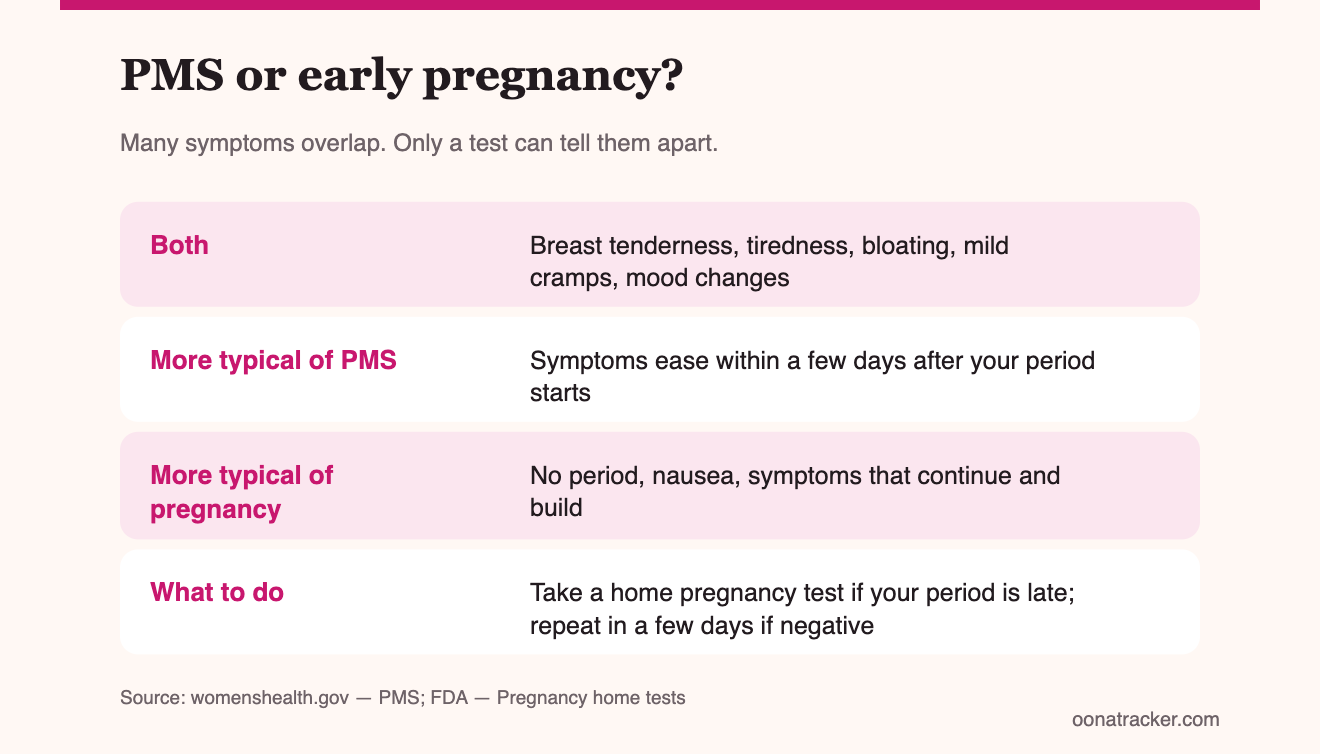
- Sore or swollen breasts
- Tiredness
- Bloating
- Mild cramping
- Mood changes and irritability
- Food cravings or appetite changes
The Office on Women's Health lists all of these as common premenstrual symptoms.
Which signs point more toward pregnancy?
- A missed period. This is the most reliable early sign.
- Nausea, with or without vomiting, is more typical of pregnancy than of PMS.
- Symptoms that continue and build after the date your period was due, instead of easing.
Which signs point more toward PMS?
- Your period starts and symptoms ease within a few days. PMS symptoms usually end within four days after bleeding begins (womenshealth.gov).
- The same pattern every month. If your notes show the same symptoms on the same cycle days for several months, PMS is more likely.
When can a pregnancy test tell the difference?
A home pregnancy test detects hCG, a hormone made only in pregnancy. In a 28-day cycle, hCG can be detected in urine 12 to 15 days after ovulation (FDA).
The FDA notes that 10 to 20 out of 100 pregnant people will not get a positive result on the first day of a missed period. For the most reliable result, test one to two weeks after a missed period, use first-morning urine, and repeat the test in a few days if it is negative and your period still hasn't come. See why your period may be late.
When to see a doctor
- Your period is late and home tests keep giving unclear results
- You have a positive test with sharp one-sided pain, dizziness or heavy bleeding — seek urgent care
- Premenstrual symptoms disrupt your work, relationships or sleep
How tracking helps you compare
Your own history is the best reference. In Oona — Period Tracker & Calendar, log symptoms each day. When your period is due, you can compare this cycle with previous ones and see whether the symptoms match your usual pre-period pattern or are new. The app can't tell you whether you are pregnant — a test can.
Oona is a tracking app. It is not a contraceptive method and not a diagnostic tool.
Sources
- Premenstrual syndrome (PMS) — Office on Women's Health (HHS)
- Pregnancy (home use tests) — U.S. Food and Drug Administration
- Your menstrual cycle — Office on Women's Health (HHS)